 Toronto Dispatch
Ontario funds 2,776 new seats at Toronto Metropolitan University
The province has invested $73 million to fund 2,776 additional seats at Toronto Metropolitan University (TMU), according to the Government of Ontario. A seat is, in effect, a place the province funds: it pays universities to teach domestic students. Of the new seats, 2,115 are in science, technology, engineering and mathematics (STEM), 627 in health and 34 in education, and they open as early as fall 2026.
The $1.7 billion figure in the announcement is the province-wide total, not TMU’s share, and supports 70,000 new seats. The first 30,000 seats were allocated in May 2026, and a call for proposals opened for the other 40,000. Ontario judged proposals on institutional capacity, local industry needs and student demand.
Nolan Quinn, the colleges and universities minister, called it “the largest seat expansion in Ontario in more than a decade”.
The money follows a period of tighter university finances, as the figures show. In 2022-23, Ontario gave its universities the lowest provincial funding per domestic student of any province, $10,246 against a national average of $16,756, the Financial Accountability Office found. Don Drummond of the C.D. Howe Institute said Ontario universities made nearly $1.28 billion in cuts and deferrals over three years, eliminating 2,500 jobs and suspending or closing 2,700 courses and programs.
The $6.4 billion funding model announced on February 12, 2026 also lets tuition rise by up to 2% a year for three years. From fall 2026, the Ontario Student Assistance Program (OSAP) will give students at most 25% of their aid as grants and at least 75% as loans.
Sources: Government of Ontario · Financial Accountability Office of Ontario · C.D. Howe Institute · Toronto Metropolitan University
Rogers' wireless revenue falls after CRTC fee ban
Rogers, which sells wireless and internet service and runs media, is earning less per mobile customer. Wireless service revenue fell 1% in the third quarter, CP24 reported, though total revenue rose to $5.44 billion from $5.35 billion. Monthly revenue per user slipped to $55.22 from $56.70.
CFO Glenn Brandt said the ban on fees to activate, change or cancel plans, in force since June, had the largest impact. The Canadian Radio-television and Telecommunications Commission (CRTC), which regulates communications, said its rules are meant to ease switching plans without unexpected charges.
Rogers added 6,000 postpaid mobile subscribers, against 62,000 a year earlier.
Rogers completed its $4.35 billion purchase of the rest of MLSE, owner of the Maple Leafs and Raptors, earlier in October. It aims to sell a minority stake in its sports and media business in the first half of 2027.
The CRTC is reviewing whether Rogers, Bell and Telus broke the ban with new fees; Rogers said one concerns an optional purchase.
Sources: CP24 · CRTC (Government of Canada)
Dayforce agrees to buy Toronto hiring-AI firm Ribbon
A Toronto start-up that uses a computer-generated voice to interview job seekers is being sold. Dayforce, which sells an AI-powered platform for HR, pay and more, said it has signed an agreement to buy Ribbon AI; BetaKit reported it was agreed on Friday. Neither the price nor the closing date was disclosed, BetaKit reported.
Ribbon’s platform screens candidates for companies; Dayforce says it has hundreds of customers and over one million completed interviews. Once the deal closes, Dayforce says, Ribbon’s technology will join its new Agentic Recruiting product. Dayforce’s chief executive, David Ossip, said AI can take over manual, time-sensitive hiring work so recruiters can engage talent and make decisions.
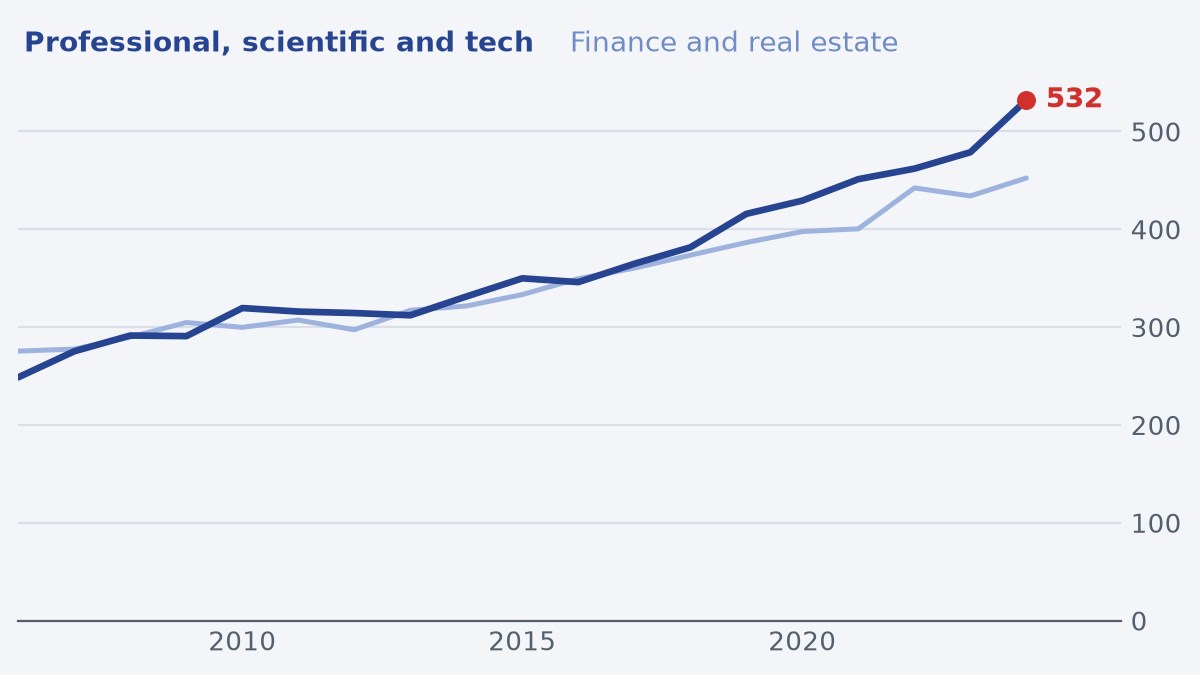
A Council of Canadian Innovators study, based on 30 founder interviews, found leadership and decision-making moved abroad after acquisition in 93% of cases, BetaKit reported. Toronto’s professional, scientific and technical jobs rose from 249,000 in 2006 to 532,000 in 2024, according to Statistics Canada.
Sources: BetaKit · Dayforce · Council of Canadian Innovators · Statistics Canada
More Golden Horseshoe building projects are now under construction
More building projects are under way around Toronto than a month ago. UrbanToronto reported that 740 projects were under construction as of October 21, up 2 from 738 a month earlier. UrbanToronto said this reverses last month’s fall.
Those projects hold 243,254 homes, up 1.8% from 239,081. Their gross floor area, the total floor space of the buildings, is about 204.2 million square feet, up 0.9%.
The figures cover 10 regions of the Greater Golden Horseshoe, including Toronto, Peel and York, not just the city. They come from UrbanToronto’s UTPro dashboard, which tracks development across the Toronto-centred region.
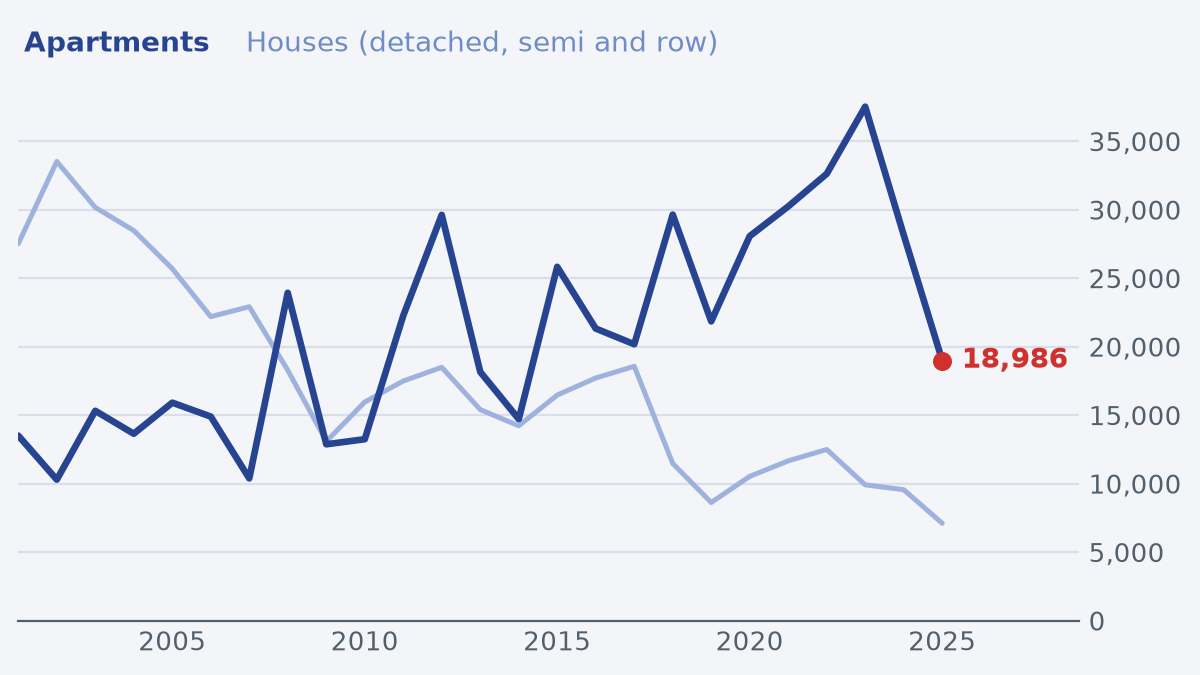
Statistics Canada counts something different: new apartments on which building began, in Toronto only. Those starts fell to 18,986 in 2025 from 28,162 in 2024, and from a peak of 37,519 in 2023. The two series should not be compared directly.
Whether October’s small rise will continue is not yet known.
Sources: UrbanToronto · Statistics Canada
Toronto apartment starts fell to 18,986 homes in 2025, down from 28,162
New homes started in Toronto, by type, homes a year
Ottawa pledges $1.75 billion to keep startups growing at home
Ottawa has pledged $1.75 billion to help Canadian startups grow at home. The Business Development Bank of Canada, a federal body, will run both programs, announced on October 22 in Toronto.
One, Growth VCCI, is a fund-of-funds: the government backs private venture capital funds, which pool investors’ money to buy stakes in young companies. It requires at least $3 of private money for every $1 of public money, BetaKit reported. The other program sets aside $675 million for later and growth stage companies and $75 million for the earliest stage.
Growth- and later-stage companies drew 10% of Canadian venture funding in the first nine months of 2026, against 37% in 2025, CPE Media & Data Company reported.
Raquel Urtasun of Waabi, a Toronto self-driving firm, said growth rounds before revenue is earned are where too many promising companies are lost.
BetaKit reported that capital could take at least 12 to 18 months to reach fund managers.
Sources: BetaKit · Innovation, Science and Economic Development · CPE Media & Data Company
Toronto’s professional, scientific and tech jobs reach a record 532 thousand in 2024
Jobs in Toronto in two knowledge industries, thousand jobs
$73 million is what Ontario has invested to fund 2,776 additional seats at Toronto Metropolitan University. That is part of a broader $1.7 billion provincial investment supporting 70,000 new seats.
Average revenue per user: the average amount a company earns from each customer each month. Rogers’ mobile phone figure was $55.22 in Q3, down from $56.70 a year earlier.
- Weather: Sunny. High 16°C. Overnight low 5°C.
- Daylight: Sunrise 07:42, sunset 18:20; 10 h 37 min, 3 min less than yesterday
- TSX: 35,788.18 at the close, down 185.27 points (The Canadian Press)

- Dollar: 71.46 US cents, up 0.14

- 5-year bond: 3.50% (it steers fixed mortgage rates)
 (as of Oct 22)
- Gas: 176.7 cents a litre for regular, down 4.8 on the week
 (as of Oct 19)
- Subway: Line 2 Bloor-Danforth: no service Kipling to Jane, all day.
- Civic: Municipal election in 2 days (Monday, October 26)
Small charts show the last seven readings: trading days for the TSX, the dollar and the bond; weeks for gas.
All the long day the vapours played
At blindfold in the city streets,
Their elfin fingers caught and stayed
The sunbeams, as they wound their sheets
E. Pauline Johnson (Tekahionwake), The Lifting of the Mist, in Flint and Feather (1912). Mohawk poet and performer (1861-1913), whose career on stage began at a recital in Toronto in 1892.
Reply to this email with a tip or a correction.
Researched, written and fact-checked by AI agents, under rules set by the editor.
360 College Street Unit 104, Toronto, ON, M5T 1S6