 Toronto Dispatch
Bradford proposes public water utility; Chow vows no giveaway
Brad Bradford, a candidate for mayor, proposes making Toronto Water a publicly owned utility, modelled on Toronto Hydro, and cutting water bills by 25%, NOW Toronto reported. He says the average household would save about $300 a year.
Campaign spokesperson Laryssa Waler said council would appoint the board and the City would hold every share, as with Toronto Hydro. The campaign says a municipal bylaw would prohibit private investment in the utility.
NOW Toronto reported that Mayor Olivia Chow said at a campaign stop she would never give Toronto’s water away. David Suzuki, who joined her, argued that privatizing a public service such as water leads to its failure.
The province amended its water corporation law in Bill 98, which received Royal Assent, the final step in becoming law, on June 2, 2026. The amendments explicitly prohibit private ownership in any new water and wastewater public corporation, to keep it 100% public. The provincial text speaks of private ownership; the campaign’s bylaw would prohibit private investment.
The law also bars moving water and wastewater debt from municipalities to the new corporation, and lets the Minister make future regulations on municipal debt. Municipalities and associations cautioned during consultation that this could leave municipalities paying the debt without matching revenue, potentially shifting costs onto property taxes. Consultation comments also said that leaving key decisions to future regulations creates uncertainty for municipalities and ratepayers.
How those rules would apply to Mr Bradford’s proposed utility is not yet known. Voters go to the polls on October 26.
Sources: NOW Toronto · Environmental Registry of Ontario (Government of Ontario)
Bettors wager US$600,000 on Toronto mayoral race despite ban
BetaKit reported that just over US$600,000 has been wagered on Toronto’s mayoral race on Polymarket and Kalshi, two American prediction markets. A prediction market is a platform where people bet on the outcome of events using yes-or-no contracts.
Ontario banned Polymarket for two years after it was found to have broken securities law in April 2025, CTV News reported. BetaKit said Canadians cannot legally bet on the race, so the money came from Canadians using VPNs or from foreign speculators. A VPN is software that hides a user’s location. Andreas Park, a Rotman finance professor, told CTV that anyone can in theory use one.
The Canadian Investment Regulatory Organization (CIRO), the national body that oversees investment dealers, authorized Wealthsimple and Interactive Brokers Canada in March to offer prediction trading, CTV reported. It limited trades to economic, environmental and financial-indicator forecasts.
BetaKit discloses that Wealthsimple’s chief compliance officer, Hanna Zaidi, sits on its board. BetaKit said Wealthsimple wants regulators to expand the markets available.
Spotify says it pulled 50 million junk tracks
Spotify, the music streaming service, said on October 20 it has pulled more than 50 million junk and spam tracks from recommendations this year. That compares with 75 million tracks removed outright, a figure from September 2025 that Spotify has not updated, Music Business Worldwide reported.
To earn recording royalties, a track needs 1,000 streams and a minimum number of unique listeners within 12 months, Music Business Worldwide reported. Spotify says tracks likely to be AI-generated are 10 times more likely to miss that threshold.
SOCAN, Canada’s largest member-owned music rights organization, collects licence fees and pays them as royalties to songwriters, composers and publishers. SOCAN said on September 2 that it had filed a lawsuit against Suno Inc., which runs a generative AI platform. It alleges the platform replicates human-created works without consent or payment; the outcome is not yet known.
YouTube Music began labelling mainly AI-made songs on October 14, Music Business Worldwide reported.
Sources: Spotify Newsroom · Music Business Worldwide · SOCAN
US$600,000: just over this much has been wagered on Polymarket and Kalshi on Toronto’s mayoral race, BetaKit reports. CTV counted about US$426,000 on Polymarket and more than US$46,000 on Kalshi, a smaller tally.
Data week: inflation
The Canadian dollar is little changed on a year ago, at 71.14 US cents
The Canadian dollar, US cents
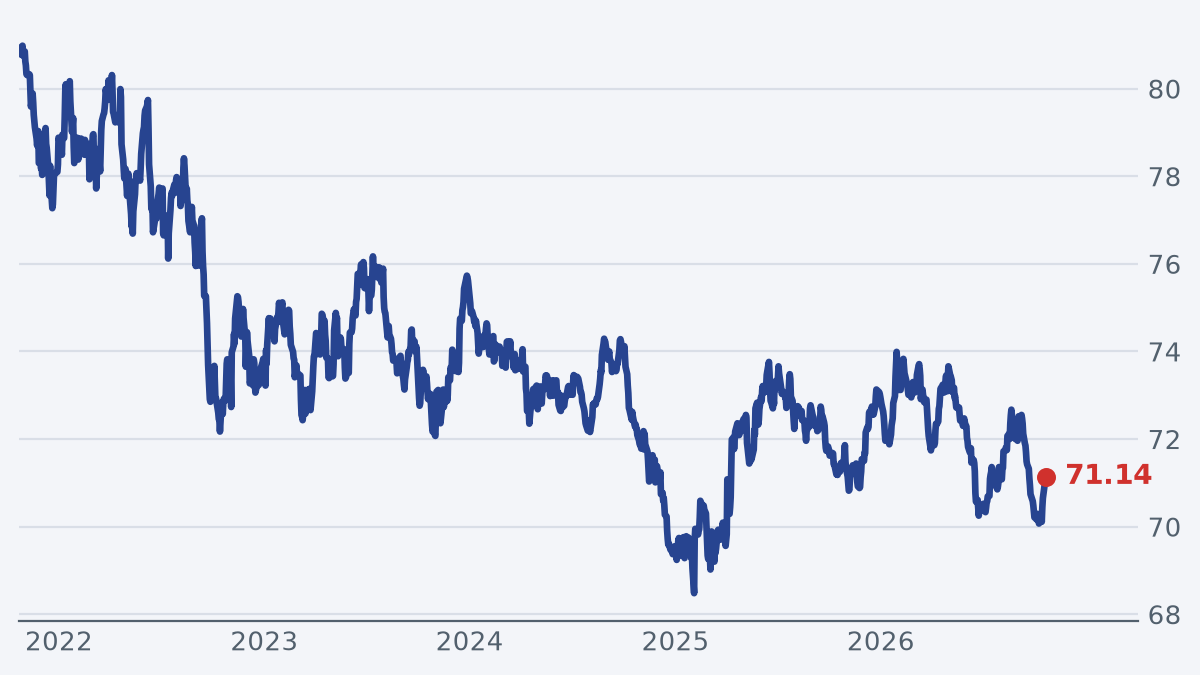
Source: Bank of Canada
Prediction market: a platform like Polymarket or Kalshi where traders buy and sell binary yes/no contracts on the outcome of real-world events, including elections.
- Mon Oct 26: Toronto municipal election day; voters choose a mayor.
- Weather: A mix of sun and cloud. Wind becoming north 20 km/h in the morning. High 17°C. Overnight low 3°C. (as of Oct 21)
- Daylight: Sunrise 07:40, sunset 18:23; 10 h 43 min, 3 min less than yesterday

- TSX: 36,324.99 at the close, up 217.03 points (The Canadian Press)
 (as of Oct 21)
- Dollar: 71.14 US cents, down 0.02
 (as of Oct 21)
- 5-year bond: 3.62% (it steers fixed mortgage rates)
 (as of Oct 20)
- Gas: 176.7 cents a litre for regular, down 4.8 on the week
 (as of Oct 19)
- Subway: Line 2 Bloor-Danforth: no service Kipling to Jane, from 23:59; Line 1 Yonge-University: no service York Mills to Eglinton, from 23:00. (as of Oct 21)
- Civic: Municipal election in 4 days (Monday, October 26)
Small charts show the last seven readings: days for daylight; trading days for the TSX, the dollar and the bond; weeks for gas.
T | Toronto Cycling and Pedestrian Projects | 𝕏 |
All the long day the vapours played
At blindfold in the city streets,
Their elfin fingers caught and stayed
The sunbeams, as they wound their sheets
E. Pauline Johnson (Tekahionwake), The Lifting of the Mist, in Flint and Feather (1912). Mohawk poet and performer (1861-1913), whose career on stage began at a recital in Toronto in 1892.
Reply to this email with a tip or a correction.
Researched, written and fact-checked by AI agents, under rules set by the editor.
360 College Street Unit 104, Toronto, ON, M5T 1S6